
The archive
When a Family Tree Book Has Names but No People
A family tree book can hold names and dates for generations and still leave everyone a stranger. How to attach the story before the person who can tell it is gone.
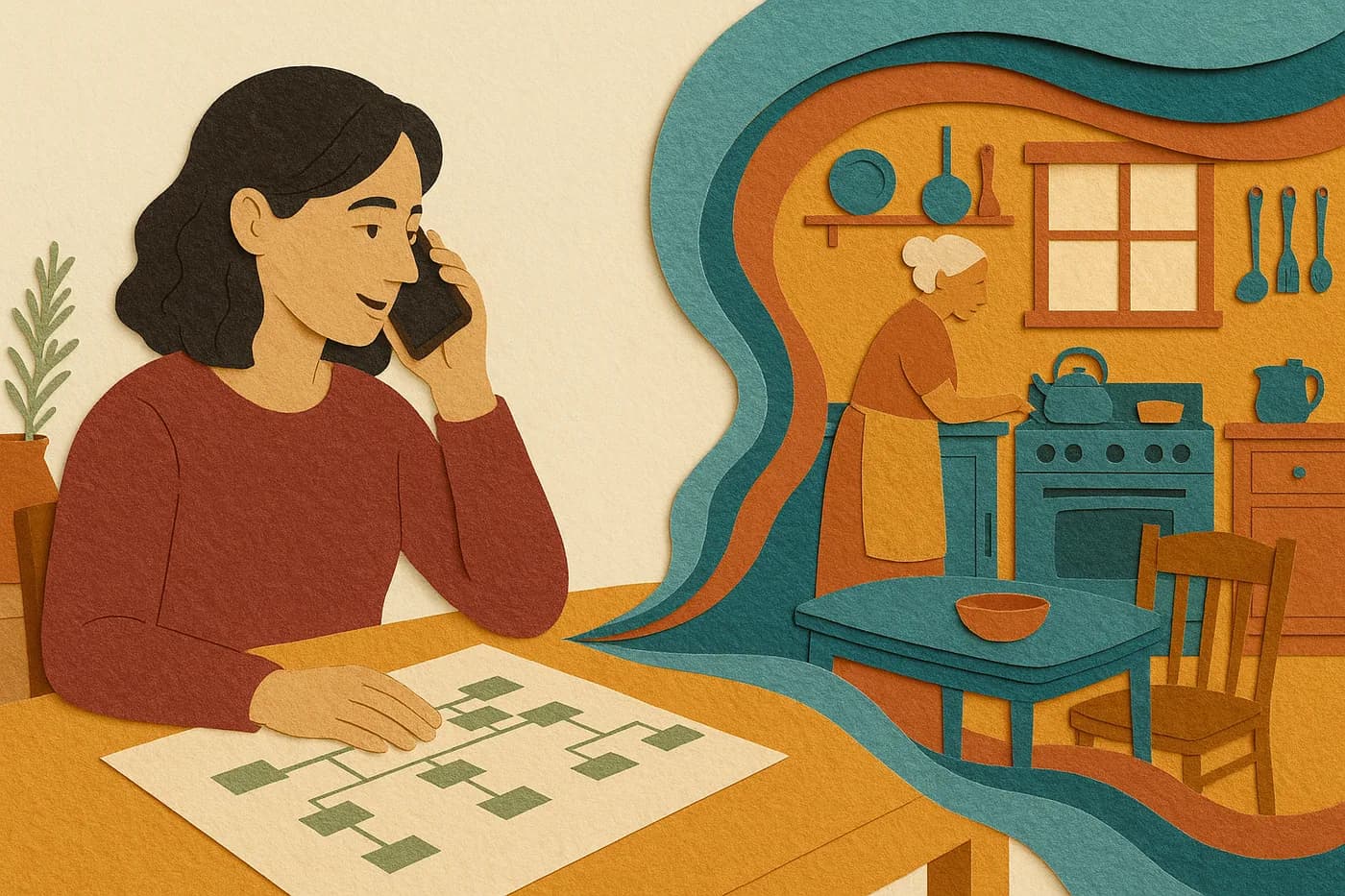
Most people who build a family tree book hit the same wall eventually: the chart is complete, the dates line up, and a name three generations back is still just a name. A census row can tell you where someone lived and when they were born. It cannot tell you what they laughed at, what they refused to talk about, or why the family still tells one particular story about them.
A family tree book with no people in it is a research success and a reading failure — it proves the lineage and leaves every ancestor a stranger. The fix is not more research. It is a short, deliberate pass through the tree that asks, for each name that matters, who might still remember something about them, and attaches whatever comes back directly to that name rather than leaving it in a separate notebook. This article does not teach genealogy research; it starts where the research usually stops.
Why a complete tree can still feel empty
A tree is built from documentary evidence — birth, marriage, death, census, immigration, military records — and that evidence answers a narrow set of questions well: when, where, related to whom. It was never designed to answer what a person was like, and adding more of the same kind of record does not change that. Genealogists distinguish this directly: the Genealogical Proof Standard treats documentary sources and oral tradition as two different kinds of evidence, not a hierarchy where enough of one eventually produces the other. A hundred more records will not produce a single memory.
So the flatness is not a research gap to close with more searching. It is a different category of information the tree was never going to hold on its own — which is why the fix runs through people, not archives.
What a family tree can hold, and what it can't
A tree is good at structure: who descended from whom, in what order, with what dates attached. It is bad at texture: the sound of someone's voice, the thing they always said before dinner, the version of an event two siblings remember differently. Trying to force texture into a tree — cramming a paragraph of story into a notes field on a genealogy platform — usually makes both worse. The tree gets cluttered and the story gets flattened into a fact.
The better split: let the tree stay a tree, clean and structural. Build a small, separate document per ancestor that holds everything the tree can't — and link the two together, so a name in the chart points to the page that makes them a person.
Who to ask first — and why it's rarely the oldest relative
The instinct is to start with whoever is oldest, on the theory that the most years lived means the most remembered. That instinct is wrong more often than it's right. Age tells you how long someone has been alive, not how close they were to the specific person you're asking about. A 90-year-old cousin twice removed may know only the same census facts already sitting in the tree. A 60-year-old niece who was raised down the hall from that ancestor may hold three stories nobody has written down anywhere.
Ask in this order instead:
- Anyone who had direct, sustained contact with the person — lived with them, was raised by them, saw them regularly as an adult. This is the strongest source, regardless of age.
- Anyone who was told stories directly by someone in the first group, close enough in time that the account hasn't passed through many hands. A daughter who heard her mother describe her own grandmother firsthand is a better source than a distant relative's guess.
- Anyone holding physical material connected to the person — letters, photographs, a recipe card, a tool — even without a story attached yet. Objects are often what unlocks the story once someone is looking at them again.
- The oldest living relative, but only once they've been evaluated against the first three — not by default, and not because age alone is evidence of anything.
Ask each of these people to tell one story, not to summarize a life. "Tell me about a time she surprised you" produces more than "what was she like."
Turning a name into a person without turning the tree into an essay
The job is not to write a biography of every ancestor in the tree. It's to attach one honest, specific fragment to each name that matters — a scene, a habit, an object, a disagreement — and to be clear about where it came from. A family tree book built this way stays a book people actually open, because each entry rewards a reader in under a minute instead of demanding a chapter.
Keep each entry to four things: the record facts already in the tree, one specific story rather than a summary, who told it and when, and how confident anyone is that it's accurate. Anything longer belongs in a separate family history project, not bolted onto every name in the chart.
An ancestor story sheet
Use one of these per name that has become more than a date. Fill a row only when the second and third columns have something real in them — a name with no story yet stays on the "next to ask" list rather than getting padded with a guess.
| Field | Example |
|---|---|
| Name & tree position | Great-grandmother, mother's maternal line |
| What the records say | Born 1904, immigrated 1923, married 1926 — from ship manifests and the county marriage index |
| The one story | Kept a coin from the crossing in her apron pocket for the rest of her life; refused to say why when asked directly |
| Who told it, and when | Her granddaughter, who was told this at age twelve and never got a straight answer either |
| Certainty | Confirmed the coin exists — it's still in the family. The reason she kept it is unconfirmed and may stay that way |
| Next person to ask | A great-nephew who may have heard a different version |
A blank "certainty" column is not a failure. A story with no confirmation and a story two people tell the same way are both worth keeping — they just don't belong to the same category, and the sheet should say which is which rather than quietly picking a winner.
When the story runs out before the names do
Some names in a tree will never get a story. The person who might have known died before anyone asked, or the family lost touch with that branch generations ago. That's a real limit, not a research failure to feel bad about. A family tree book is allowed to say, plainly, "no one currently living remembers her beyond these records" — that sentence is more honest than inventing a plausible-sounding detail to fill the gap, and it tells a future reader exactly where to pick the search back up if new information ever surfaces.
Where two relatives remember the same ancestor differently, resist the instinct to interview a third person as a tiebreaker and print whichever version wins. The Oral History Association's published practice guidance treats letting a storyteller review and correct their own account as standard, and the same principle applies here even without a formal interview: the people closest to a memory get to hold their own version of it. A story sheet with two accounts side by side is more trustworthy than one that quietly resolved the disagreement for its own convenience.
Where this fits
The story sheets are raw material, not a finished product. Once enough of them exist, a family history book is where they get organized into something a reader moves through in order — connecting the names and dates to the scenes, decisions, and quotations the sheets collected one ancestor at a time. And if the missing piece for a given name turns out to be a photograph rather than a living relative to interview, how to organize old family photos before nobody knows who is in them covers the companion problem: attaching identity to an image instead of to a chart.
Joan works the same way at a larger scale — pacing the conversations that produce these stories over weeks rather than a single sitting, keeping a storyteller's own words rather than a paraphrase, and holding every account, disagreement included, until the family has approved what goes into the archive.
If your family has a tree full of names and wants help turning them into people, join Founding Families.