
Conversations
Questions to Ask Aging Parents Without Turning the Visit Into an Assignment
A short, specific set of questions to ask aging parents — plus how to pace a visit so it stays a conversation instead of an errand.
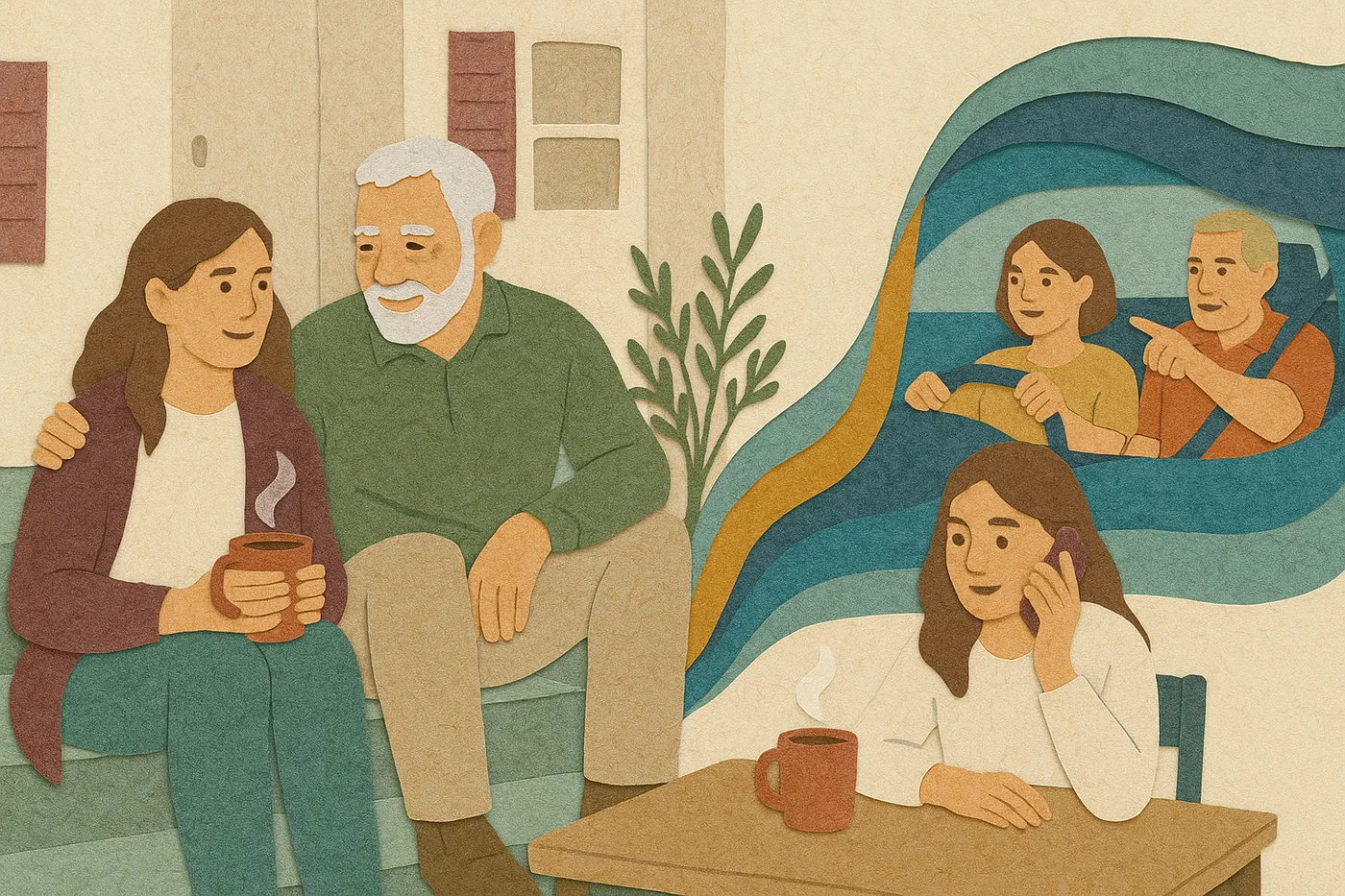
A visit starts to feel like an assignment the moment it arrives with an agenda: the pharmacy, the paperwork, the three things someone meant to ask last time and wrote down so they wouldn't forget. None of that is wrong to bring up. But when every visit is logistics first, the person on the other end of it can start to feel like a set of tasks rather than someone with a life still worth asking about.
The best questions to ask aging parents are specific, few, and unscheduled — one or two real questions folded into an ordinary visit, not a sit-down interview. Ask about a place, a decision, or a person by name, then follow whatever comes back instead of moving to the next item on a list. A short answer or a change of subject is a boundary being set in real time, not a gap to fill on the next visit.
What makes a visit feel like an assignment
It is rarely the questions themselves. It is the pacing. A visit that opens with "we need to talk about the house" and closes with "did you take your pills" leaves no room in between for anything that isn't a task. The story questions get squeezed into whatever minutes are left, asked quickly, and answered quickly to match.
The fix is not a separate "story visit" scheduled on top of the practical one — most families do not have that kind of spare time, and a separately calendared interview can feel more like an assignment, not less. It is smaller: pick one question, ask it in the middle of an ordinary task — folding laundry, waiting for a kettle, riding in the car — and let it sit there without a follow-up appointment attached to it.
A few questions to ask aging parents, and how to ask them
Concrete questions work better than open ones. "Tell me about your life" is too large a door; "what was the first car you ever drove" has an actual handle on it.
A place. "What did the kitchen look like in the first house you remember?" Objects and rooms carry people with them — the radio, the argument about paint, who sat where.
A decision. "Was there a job you almost took and didn't?" or "what made you decide to move here?" The useful follow-up is almost always "what did you think would happen at the time," not "was that the right call."
A person. "Who was the funniest person in your family when you were young?" Every family has someone who now exists only as a name. A question aimed at a person, not an event, is how that changes.
An ordinary detail. "What did things cost, that you remember the exact price of?" or "what did you listen to that your parents hated?" Small, specific questions frequently produce more of a person than the large ones do.
Two of these in one visit is plenty. A list this size is a menu to choose from, not a script to complete.
Adjust for hearing, energy, and comfort — not memory
If a question needs repeating, or an answer trails off after a few sentences, that is usually about hearing or stamina, not about memory — and it deserves the same patience either one would get. Sit where your parent can see your face if lip-reading helps at all. Keep the harder or more open-ended question for whatever time of day they're usually most alert, not whichever time happens to fit your schedule. Stop before anyone is tired rather than pushing to finish a thought.
None of this is a reason to infer anything about cognition. A slower or shorter answer is information about the moment — noise in the room, a long day, a question asked too late in the evening — not a diagnosis to work backward from. Adapting the pace is simply good manners extended to someone whose hearing or energy has changed; it is not a clinical read of anything else.
Some doors stay closed — and that's fine to leave
Not every question gets a real answer, and a change of subject is not a failure of the question. If a topic gets one flat sentence and then a shift to the weather, that is the boundary, and it is worth respecting in that same conversation rather than circling back to it before the visit ends. Note that the door was there. Try again gently, much later, if at all — and only if it feels like an invitation is wanted, not owed.
A one-visit plan, if a plan helps
Some people do better with a light structure to lean on rather than winging it. This is meant to be used once and adjusted, not treated as a script:
| Before the visit | During the visit | If the answer is short | |---|---|---| | Pick one or two questions, not a list. Write them somewhere you won't lose them. | Ask during an ordinary task — a drive, a chore, a meal — not as a sit-down moment. | Say "okay" and let the subject change. Don't ask why, and don't ask again that same day. | | Note the practical things separately, so they don't crowd out the story questions. | Follow the answer with "what happened next" more than with a new question. | Write down that the door was there, so you remember for next time. | | Pick a time of day your parent is usually rested, not just whenever you're free. | Watch for tiredness and end before it becomes a struggle to keep going. | Come back to it weeks later, if at all — never in the same visit. |
What to do with what you hear
A remembered account is not the same thing as a verified fact, and it is worth keeping that distinction rather than smoothing it into a tidy story. If a parent and a sibling remember the same year differently, write down both versions instead of picking whichever sounds more confident. The Oral History Association's published guidance on narrator review — letting the person who told the story see and correct what was recorded before it is treated as settled — applies just as well to a note jotted down after a visit as it does to a formal recording.
For the broader version of this — questions that work across a parent's whole life, not just a single visit — see Questions you'll wish you had asked your parents. And for the practical side of fitting this into visits that already have plenty on the agenda, Preserve a parent's stories without giving them homework covers how to do this without adding a project to anyone's plate.
Joan asks questions like these over time, in ordinary phone conversations, pacing them the way this piece describes — one or two at a time, following what's actually said, leaving closed doors alone. If your family is ready for someone else to hold that pacing, join Founding Families.